Latest survey: Strong public support for the 2% tax allocation model, which provides tangible help to people
The scheme allowing taxpayers to allocate 2% of their income tax to civil society organisations enjoys strong public support. A new representative survey has found that a large majority of respondents want the model to remain in place, despite ongoing efforts to consolidate public finances. People would mostly like to see these funds used to help those in need and support healthcare and social services.
Despite the often-polarised public debate surrounding non-governmental organisations, support for the 2% tax allocation remains very strong in Slovakia. This is according to a new representative public opinion survey presented by the Association of Corporate Foundations and Funds (ASFIN) as part of the Pomáhame spolu (Helping Together) initiative.
The 2% tax allocation scheme remains one of the most widely supported mechanisms for funding NGOs in Slovakia. As many as 79% of Slovaks believe that individuals should continue to have the option of allocating 2% of their income tax to non-profit organisations. When it comes to companies, 74% of respondents support retaining the model.
Support remains high even when respondents consider the ongoing consolidation of public finances. In this context, an overwhelming majority would still support keeping the scheme in place – 75% for individuals and 71% for companies.
“The survey results provide strong confirmation that the public recognises the value of the work carried out by non-profit organisations and wants to retain the right to decide where a portion of their taxes goes, whether as individuals or businesses. The 2% tax assignation model is an expression of citizens’ trust in organisations that help people in need, support schools and healthcare facilities, and strengthen local communities every day. This is precisely why we launched the Pomáhame spolu initiative – to highlight the real stories and achievements that often would not have been possible without public support and the 2% tax allocation,” says Tatiana Švrčková, Chair of the Association of Corporate Foundations and Funds.
Radana Deščíková, Senior Manager for Donor-advised Funds at the Pontis Foundation, sees the survey results as an endorsement of a mechanism that enables companies to help address society’s needs.
“Businesses have played an important role in driving significant changes, particularly in education. I am pleased to see that they are also recognising needs that have long been overlooked, such as mental health, societal resilience, and hospice and palliative care. I believe they have demonstrated their ability to identify where support is most needed. The next step could be to provide regular funding for the organisations beyond the 2% scheme, enabling them to plan ahead, retain skilled professionals and deliver support over the long term,” she emphasises.
Public debate about NGOs is seen as confrontational
The survey also shows that allocating 2% of income tax is the most common way of supporting the non-profit sector. More than a third of respondents (39%) have used this option, compared with 30% who have made a financial donation to an organisation and 17% who have volunteered. The most common recipients of the 2% allocations were hospitals and healthcare facilities, charities, schools and nurseries, and animal shelters.
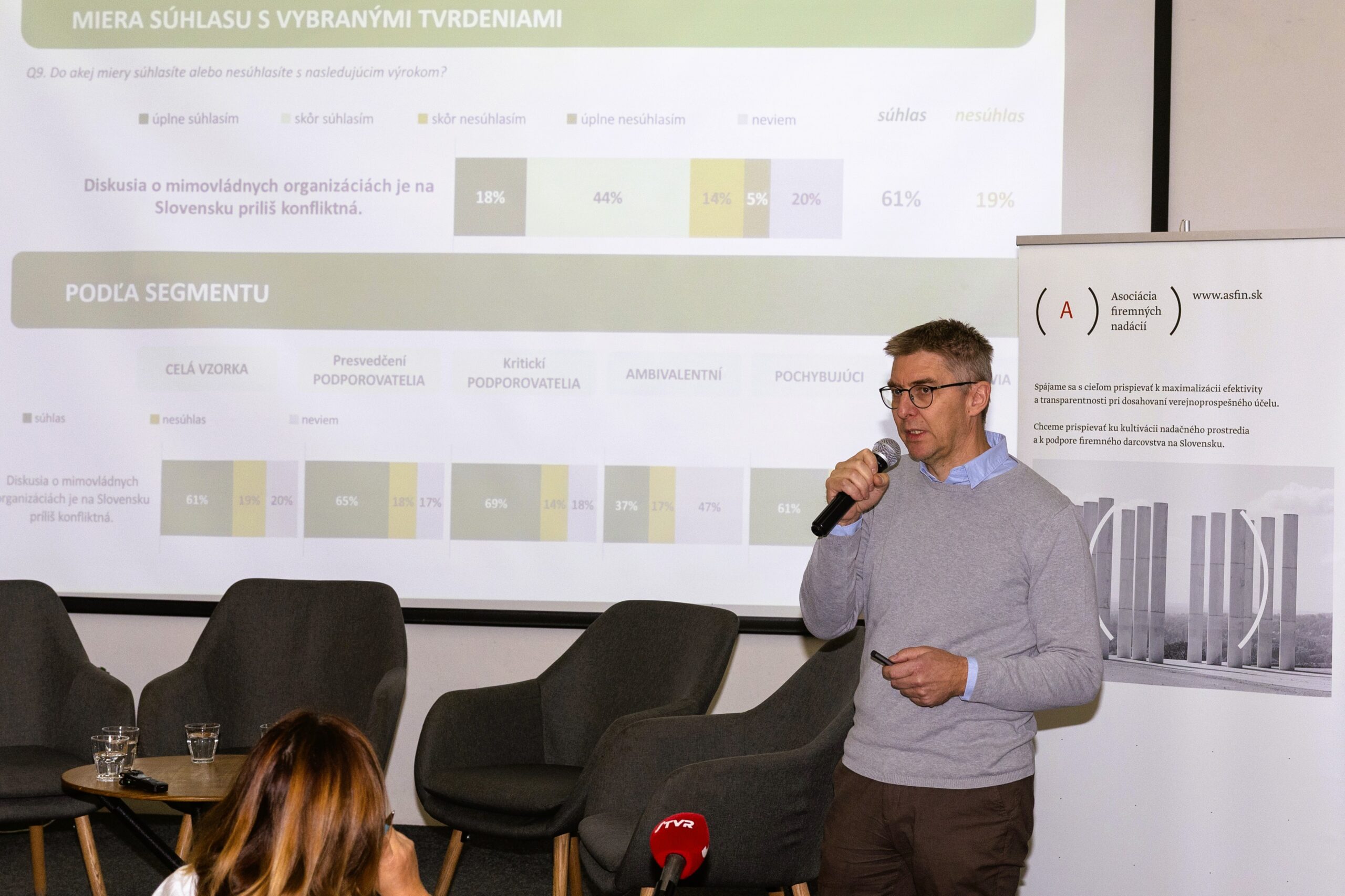
Sociologist Martin Slosiarik, Director of the FOCUS research agency.
Martin Slosiarik, a sociologist and Director of the FOCUS research agency, highlighted an interesting paradox revealed by the new data following a period of fiscal consolidation.
“The public is divided in its trust in NGOs, yet there is much greater agreement when it comes to the practical help they provide. Six in ten people consider the debate about NGOs to be overly confrontational, while two-thirds acknowledge that many of these organisations provide tangible and valuable support. From a sociological perspective, this suggests that people distinguish between the general image of NGOs presented in public debate and what these organisations actually do in their communities. Even people with differing views of NGOs can find common ground on where the 2% tax allocation should go – primarily to people in need and those requiring healthcare or social support. A critical attitude towards NGOs does not necessarily mean rejecting the help they provide,” says Martin Slosiarik.
People want the 2% allocation to help where it is needed most
As many as 65% of respondents agree that many NGOs provide tangible and valuable help to people, while 58% believe they make an important contribution to society.
The findings also show that the public has a clear idea of where funds from the tax allocation should go. More than half of respondents (51%) would direct them towards social assistance for people in need, while almost half (46%) would prioritise healthcare and social services. Education comes next (22%), followed by environmental protection (20%).
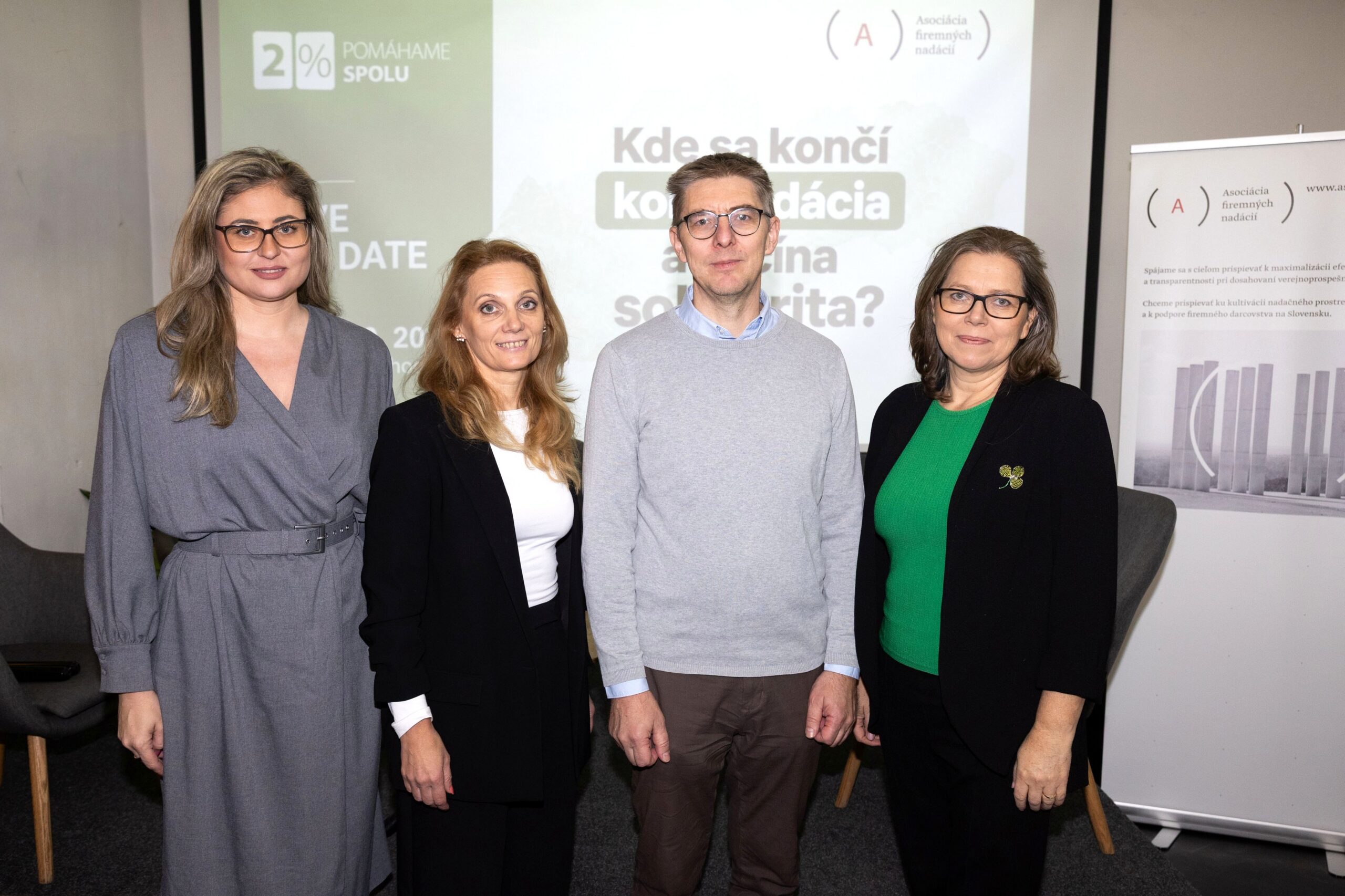
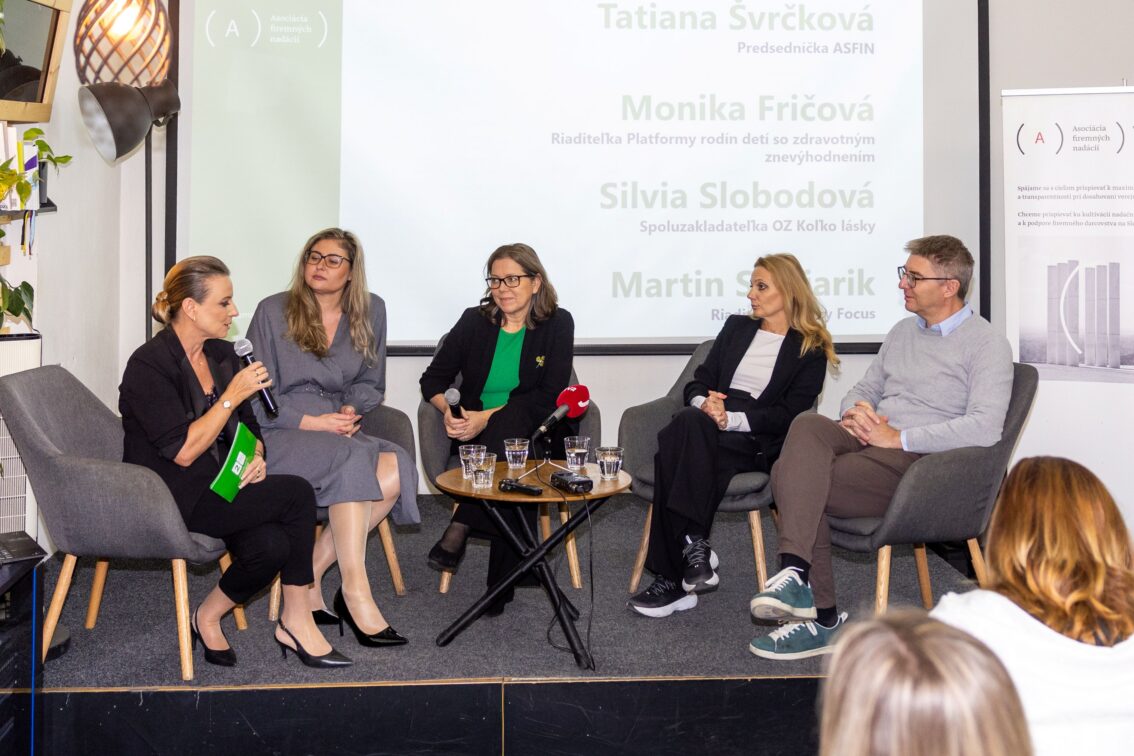
From left: Silvia Slobodová, Tatiana Švrčková, Martin Slosiarik and Monika Fričová.
Without the 2% mechanism, non-profit organisations would struggle or cease to exist
Respondents also recognise the importance of the tax allocation model for the functioning of civil society. Almost a third (32%) believe that non-profit organisations would operate significantly less effectively without funding from the 2% mechanism, while nearly half of Slovaks expect that abolishing it would have serious consequences for their activities.
“Grants often cover the costs of specific projects, but the costs of running and managing an organisation remain unfunded. Even the help we provide from the heart needs someone to coordinate it every day – communicating with care facilities, connecting volunteers, planning activities and handling everything that needs to be done. We use the 2% tax allocation precisely to cover these less visible but essential costs. A significant loss of this funding would weaken our ability to organise support and deliver it to older people. We would certainly have to scale back some of our projects. The willingness to give a gift box to an older person is incredibly valuable, but we also need to ensure that the gift actually reaches the person waiting for it. And we need to make sure that support is not just a one-off gesture at Christmas, but that older people feel seen and valued in their communities throughout the year,” explains Silvia Slobodová, founder of Koľko lásky, a civic association dedicated to supporting older people.
“As many as 87% of parents of children with disabilities experience a deterioration in their mental health because of long-term caregiving responsibilities. Without the 2% tax allocation model, we would not be able to provide these parents with support through peer counselling, our information portal or our telephone helpline,” emphasises Monika Fričová, Director of the Platform of Families of Children with Disabilities.
The survey also reveals that public debate about NGOs is often polarised. As many as 61% of respondents described it as overly confrontational. According to the Pomáhame spolu initiative, this makes it even more important to highlight facts and the real impact of organisations working in communities across Slovakia.
The survey was conducted by the FOCUS research agency through online data collection between 5 and 10 June 2026, using a representative sample of 1,033 Slovak residents aged 18 and over.