
Survey: People in Slovakia Believe in the Power of Elections but Fear for Democracy
For the first time, Slovakia has measured perceptions of the state of democracy through the Democracy Perception Index. According to the results, people have strong confidence that elections can change the direction of the country. At the same time, however, Slovakia ranks among the European nations with the greatest concerns for the pillars of democracy. The survey was conducted by the Pontis Foundation in cooperation with the Focus agency.
Slovakia participated in the global Democracy Perception Index (DPI) survey for the very first time. The index shows how people perceive democracy and how well governments in individual countries uphold basic democratic principles—freedom of expression, the rule of law, transparency of governance, and the peaceful transfer of power.
“We considered it important to add our country to the map of surveyed nations. We believe that the results of the survey can support discussion about the state of democracy by showing Slovakia in the context of more than a hundred countries worldwide,” explains Martina Kolesárová, Co-CEO of the Pontis Foundation, which initiated the survey.
Across Europe, the public tends to rate the functioning of democracy rather negatively. “The best ratings are achieved mainly by the Nordic countries, such as Norway, Denmark, and Sweden, which scored above 3.3 on the maximum five-point scale. By contrast, Serbia and France are among the countries with the weakest results, below the threshold of 2.5,”explains Martin Slosiarik, director of the Focus agency.
In Slovakia, the DPI reached a value of 2.98. This indicates that democracy is perceived as functional, but with significant shortcomings.
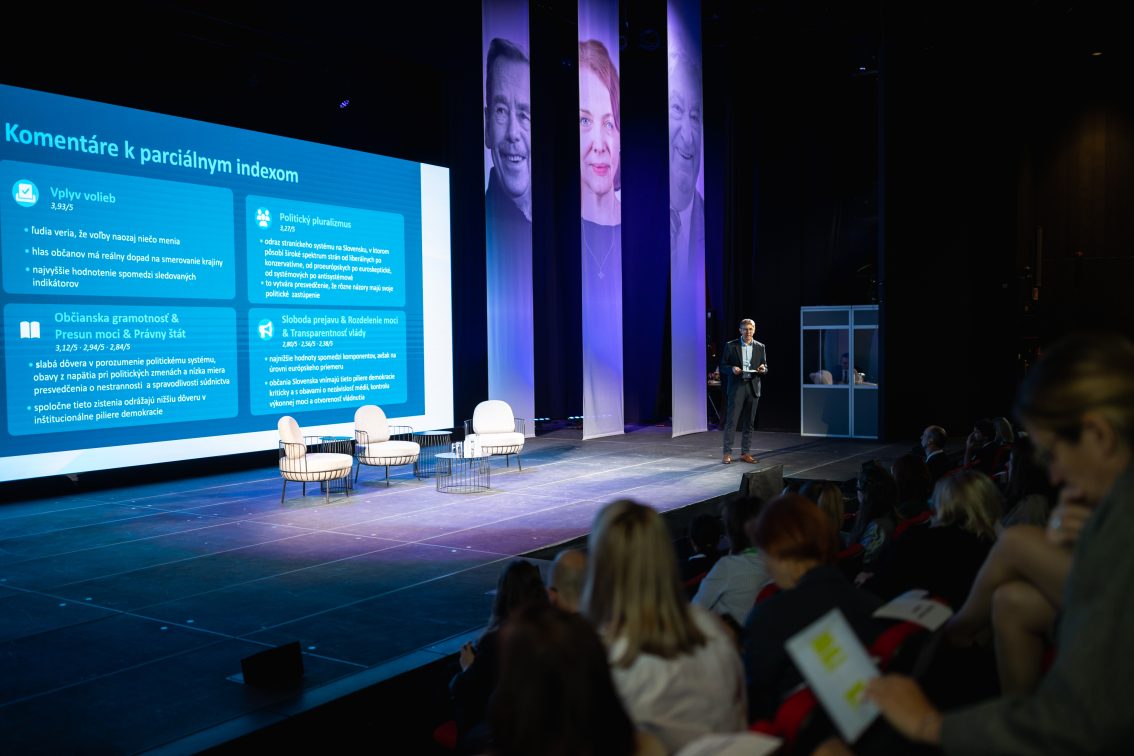
The most positively evaluated factor was the impact of the elections. The public believes that elections truly bring about change and that citizens’ votes have real impact on the country’s direction. In this regard, Slovakia scores higher than other European countries. The second-highest rating was given to political pluralism. People perceive that there is a wide spectrum of political parties and opinions in Slovakia, which strengthens the sense that different values are represented.
Read also:
- 63% of Slovaks Trust Companies, but One in Five Will Never Forgive Their Past
- They Want to Create a Better World. Who Are the Ten Finalists of 2025 Impact Summit #nextgen?
By contrast, civic literacy, the peaceful transfer of power, and the rule of law scored worse than the European average. There is low self-confidence in understanding how the political system works, as well as a low level of belief in the impartiality and fairness of the judiciary. People also express significant concern about tensions during political changes and the handover of power. Taken together, these findings reflect lower trust in the institutional pillars of democracy.
The survey reveals another interesting finding. Approximately three quarters of people consider it very or extremely important for the country to be democratic. “In Hungary or Georgia, however, as many as 85 percent or more of the public perceive this importance. Therefore, we want not only to name the strengths of our democracy and point out its weaknesses, but also to explore the causes and seek solutions. This is also why the Pontis Foundation organizes the Impact Summit, which responds to this need and brings together key people from business, civil society, and public administration,” concludes Martina Kolesárová.
The Democracy Perception Index is a global public opinion survey on perceptions of democracy, conducted in approximately 100 countries worldwide. It was developed by the German research agency Nira Data in cooperation with the Alliance of Democracies Foundation, founded by former NATO Secretary General Anders Fogh Rasmussen. The index is measured on a scale from 1 (lowest score) to 5 (highest score).
The DPI survey in Slovakia was carried out by the Focus agency in October 2025 on a representative sample of 1,028 residents of Slovakia aged 18 and over.
More information about the Impact Summit event can be found at this link.